

|
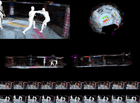
Hi, I’m a master’s architecture student struggling to clearly formulate the core claim of my diploma thesis. My project traces a genealogy of the image: from representation (image as something that refers to a reality) to what I define as spatio-temporal ubiquity: a condition in which images are no longer bound to a fixed place or moment, but exist as continuously accessible, reproducible, and spatially distributable data. Images become persistent, mobile spatial entities rather than static representations. I’m currently able to spatially reconstruct “events” such as film scenes by extracting bodies, camera movements, and 3D environments from image sequences. A film becomes navigable space. What I’m struggling with now is this: technically, I can apply this workflow to almost any image sequence. But precisely because of that, I’m stuck. I don’t know which footage would actually strengthen my (still forming) claim. Since everything can be reconstructed, my question becomes: what should be reconstructed.. and why? I have the feeling that I’m missing a clear criterion for selecting the right "raw material", and without that, the argument remains vague. I feel stuck at this point and would really appreciate thoughts on how to approach this more strategically. submitted by /u/zzala_ri |
I’m able to spatially reconstruct any event from an image sequence and now my thesis is stuck
Subscribe Today
GET EXCLUSIVE FULL ACCESS TO PREMIUM CONTENT
SUPPORT NONPROFIT JOURNALISM
EXPERT ANALYSIS OF AND EMERGING TRENDS IN CHILD WELFARE AND JUVENILE JUSTICE
TOPICAL VIDEO WEBINARS
Get unlimited access to our EXCLUSIVE Content and our archive of subscriber stories.