

There is no gainsaying Usman Khawaja’s significance as an Australian Test cricketer; an additional mark of his stature is that he almost made you take him for granted.
Think on it for a moment, and run your eye up and down the palely conventional list of Australia’s highest Test scorers, where he ranks 15th, between Mike Hussey and Neil Harvey – so various in methods yet so similar in origins. There was a recognition through the 1990s and into the 21st century that the face of Australia was being changed by immigration, while the face of Australian cricket remained eerily unaltered. Then, all of a sudden, 15 years ago, Khawaja’s darkly slim figure emerged from the shadows of the Sydney Cricket Ground to pull his first Test delivery for four, and the axis of the game tilted ever so slightly.
Yet he wasn’t there for looks. He wasn’t your affirmative action pick; he wasn’t your diversity hire. He amassed big runs, and in Test cricket too. Playing no international white ball cricket after the 2019 World Cup, he became one of the dwindling band of specialists in a multi-format world, moving at his one-man tempo with his singular technique. His contemporaries Steve Smith, a batting wonk, and David Warner, a polychrome pioneer, were uncompromising moderns. In a world in thrall to power, Khawaja remained a touch-playing treat to watch, throwing back to the ancient idea of the minimum of effort for maximum of effect, even as he partook of batting’s new possibilities. As others’ check drives rocketed to mid-off, nobody in our era defended like Khawaja, his soft hands easing the ball to the ground as though comforting a patient. At the same time, he popularised the reverse sweep so understatedly it ceased to seem outre.
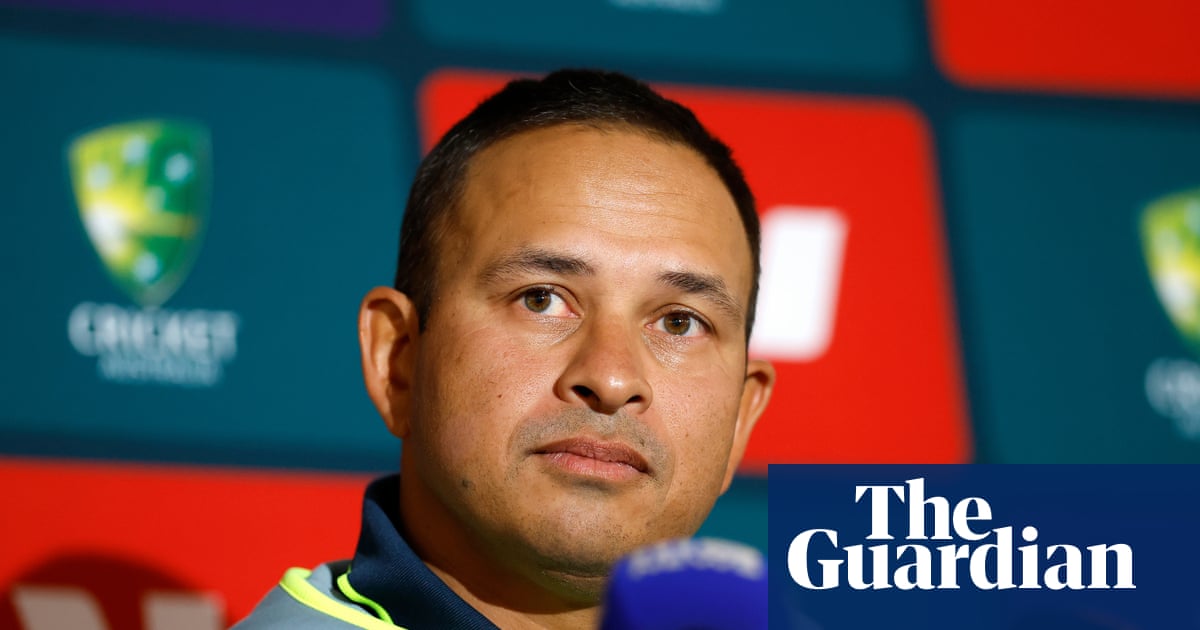
Sydney is a ground used to farewells, including of great triumvirates in 1984 and 2007. Khawaja’s public valediction today, however, will stand alone: it was frank, moving, wide-ranging, well-judged, and went places one can hardly recall a press conference going in a long time, including into his relationship with his own God, and about his country’s present dividedness. Was Khawaja a hugely outspoken athlete? By historic standards, perhaps not; by contemporary standards, which are predicated on corporate telegenia and pitched into chaos by anything other than “the boys done well”, he was made to seem like Ali and Jackie Robinson rolled up together. Viz Boxing Day two years ago, when a gesture of the utmost inoffensiveness was fanned into the flames of a bizarre cause celebre.
Not one to avoid a point, however, Khawaja this morning went into the sensation of feeling racially stereotyped for his approach to the game – he felt judged harshly on his dedication, his resilience, his attitude to training. He had a point of course. Every player who lasts any length of time attracts cliches like a magnet does iron filings. Sometimes, this is a form of essentialism. How much were Warner, or Ricky Ponting and Darren Lehmann before him, apprehended by their working-class origins? Friend of Et Al Ed Cowan, meanwhile, seemed impossible to describe without mention of his Cranbrook education. In part this is because of a profound belief that cricket is bred in the bone and expresses character. But with Khawaja, it is true, it had an additional orientalist edge; he was evaluated by standards peculiar to him, an exotic in a straitening time, a man of faith in a secular age. It still seems staggering that, in an Australian era not overendowed with batting talent, Khawaja has played in only 87 of the 153 Tests since that aforementioned debut.
Inside every player lurks a secret stat: Khawaja today clearly relished the final symmetry of his career, its cleaving into 44 Tests either side of his 2019 omission. The difference scarcely sounds so great, that in the former he averaged 40.66 and in the latter 46.1. Yet Khawaja gave an insight into how profound were the influences of his religion and his marriage on the player he became after that hiatus – providing, in fact, some empirical support for the idea of cricket as an expression of character, by articulating how he became a better cricketer as he became a better man.
He also provided a terrific exposition of the challenges of opening the batting, of the permanent pressure, of the psychological attrition. “It’s not just tough on the field, it’s tough on the brain.” I’ve heard other cricketers on retirement insist that they’ll “never forget how hard it is”; they always do, because, in part, they must, in order to testify objectively. But there was a hint here of a formidable commentator in the making.
In recent times, Khawaja has been judged against another stereotype – that of age. He is in his 40th year. Only Bradman, Lindsay Hassett and Bob Simpson before him commanded Australian Test places so old. It’s not being unkind to observe that his record has attenuated in the last two years. It’s evidence, in fact, of the same attrition he described, while his irritation about this was an outcome of the kidology in which all athletes indulge towards the end while striving to convince themselves they remain up for the fight. In Tom Brown’s Schooldays, the boy hero timelessly observes: “The goddess who presides over cricket likes to bring down the most skilful players.” Just occasionally, too, that divinity winks. In Adelaide, Khawaja, dropped on 5, went on to the gorgeous 82. It was like watching him convince himself, as he did others, that the spark still burned.
It is a truism that athletes die twice, the first time when the sporting days that defined them end, even if very seldom is that retirement accompanied by a sense of something greater lying ahead of the surviving individual. Of Khawaja, however, that is assuredly true. He has done good work already. He will not go gentle. There will be hits and misses along the way, one fancies. But for that, cricket will have provided a sound preparation.