
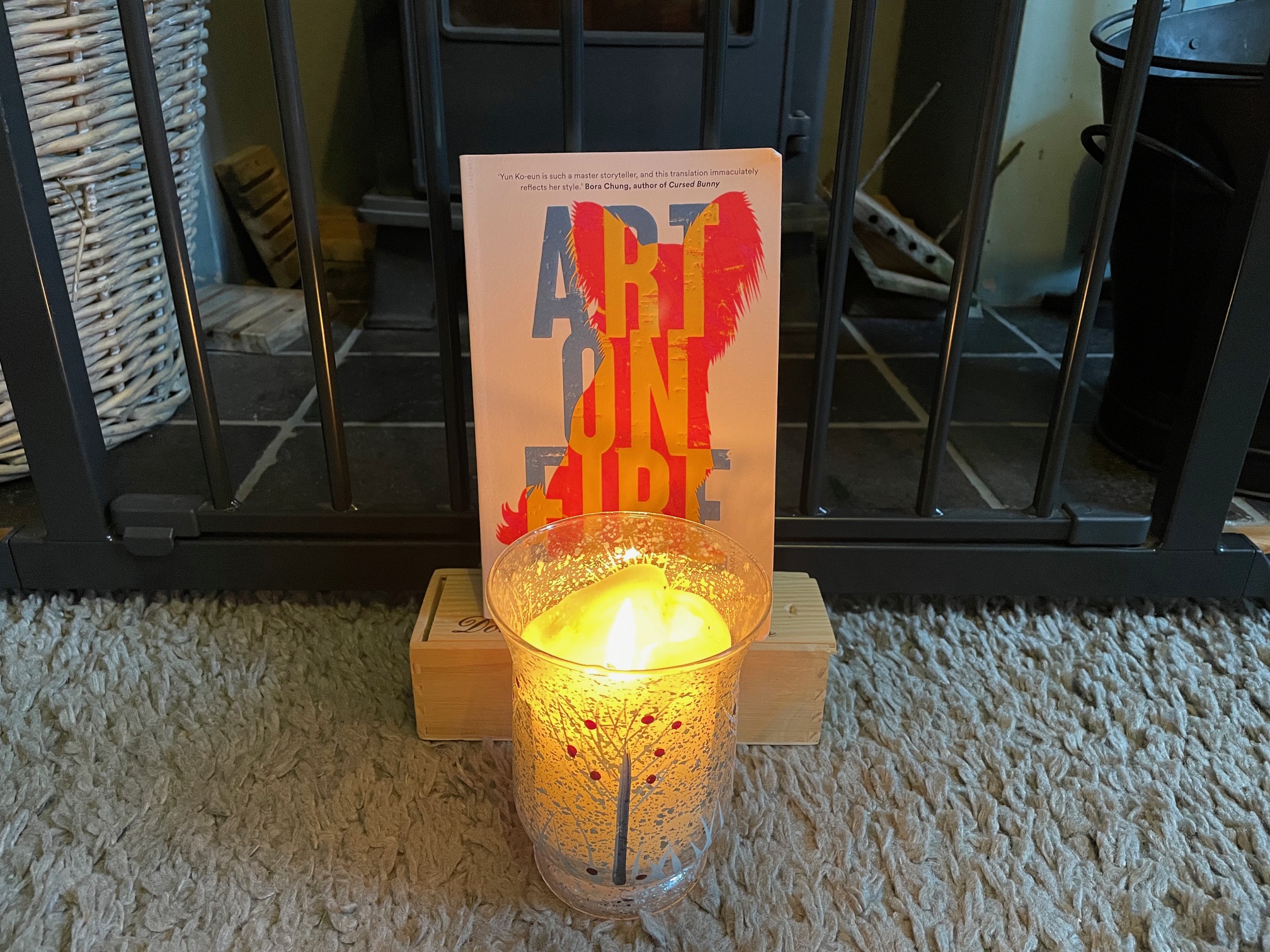

‘What have you got in that you’re excited about?’ I asked Hunter at the Folkestone Bookshop when I popped in a while back.
As often happens when I walk into that place, this was the start of a long, fascinating conversation, in which I was ushered from shelf to shelf and table to table, and shown multiple tempting titles, many of them originally written in languages other than English.
I bought several, but one in particular stuck in my mind: Yun Ko-eun’s Art on Fire, translated from the Korean by Lizzie Buehler. It was the premise that got me. Since I read the hilarious Lake Como by Srđjan Valjarević, translated from the Serbian by Alice Copple-Tošić, for Serbia during my 2012 year of reading the world, I’ve had a weakness for novels that poke fun at art residencies. Indeed, beyond the titles I’ve featured on this blog, one of my favourite reads of this year was Ella Frears’s Goodlord, a book-length narrative poem in the form of an email to an estate agent, which features a section describing a disastrous experience at an artists’ retreat.
Art on Fire sounded like it was cut from similar cloth. Struggling artist turned food-delivery person An Yiji thinks her luck has turned when she is awarded a residency at the prestigious Robert Foundation in California. But there is a catch: the programme is overseen by Robert, a wonderdog who takes photographs and selects the participants, and at the end of each artist’s time at the Foundation, he chooses one piece they have created to be burned.
As the premise suggests, this is a novel that teeters on the surreal. So much about An Yiji’s experiences is recognisable – from the Californian wildfires that delay her collection from the airport to the lumbering mechanisms of the art world – and yet everything feels as though the contrast has been shunted up a notch or two, making the colours faintly cartoonish.
Nowhere is this more true than with the figure of Robert, the Foundation’s eponymous and unnervingly gifted dog, who communicates by means of a mysterious black box and several interpreters. He has very particular views on how artists should interact with him and writes An Yiji a series of passive-aggressive letters that keep her constantly on edge.
Coupled with the narrator-protagonist’s heightened mental state, this makes for an intense and often very funny read. An Yiji is so riddled with imposter syndrome that when the Robert Foundation’s director phones to offer her the placement, she assumes it’s a spam call. Perhaps as a result of the run of disappointments that have dogged her career, she tends to look for the worst in situations. To read her encounter with the skewed logic of the Foundation is to be taken into the fraught mindset many of us may have experienced during the height of the pandemic, when months of isolation made even the simplest things strange.
This unpeeling from reality allows Yun Ko-eun to show up the cracks in many of the things we take for granted. The uneasy relationship between art and commercialism comes under the spotlight, for example, when representatives from the nearby town of Q court An Yiji in the hopes that she will feature their businesses and settings in her work. There’s a brilliant interrogation of the concept of authenticity, which is approached from many angles and comes to a head through the fact that An Yiji’s story is being developed into a film by an actor she met on her way to the residency, who needs her to work with him and the director to decide the ending.
Perhaps most fascinating of all is the discussion of translation that runs throughout the pages. Robert’s approach to communication is intriguing: ‘While humans communicated with one another line by line […] Robert saved the entire space-time of a conversation in his head, like an enormous file transfer system.’ This means that there are several stages – and people – required to compress and reorder human utterances into messages he can digest. What’s more, although An Yiji speaks English, during their conversations she is required to speak through a Korean translator. She becomes enraged when she realises the intermediary is swapping her words for terms Robert prefers during their conversations, with the result that ‘phoenix’ becomes ‘Korean pigeon’ and ‘coffin’ becomes ‘supercar’.
Knowing that we are reading all this in Lizzie Buehler’s translation adds another level to the satire, making this a wonderful example of a book where the translation offers even more than the original.
And Art on Fire certainly offers plenty to start with. It is a rare instance of a deeply funny, feel-good book that has important, thought-provoking things to say about the world we inhabit. Reading it, I was reminded of the words of Eritrean writer Alemseged Tesfai, who told me about the use of humour in his work: ‘Say the unsayable light-heartedly and maybe it hits its target.’ Art on Fire hits its target repeatedly and gives us a lot of entertainment in the process. Highly recommended.
Art on Fire by Yun Ko-eun, translated from the Korean by Lizzie Buehler (Scribe, 2025)
Thanks so much to everyone who has read my work, attended my events and bought my books this year. Your support, enthusiasm and suggestions play a huge part in keeping me going. If you’d like to join the free Incomprehension Workshop taster on Tuesday 20 January 2026 at 7.30pm GMT, please register here: https://us02web.zoom.us/meeting/register/mvu2Yq8uRdCOZCinIaj_kA#/registration
Wishing you all a very happy New Year and many wonderful reads!